
Work Packages
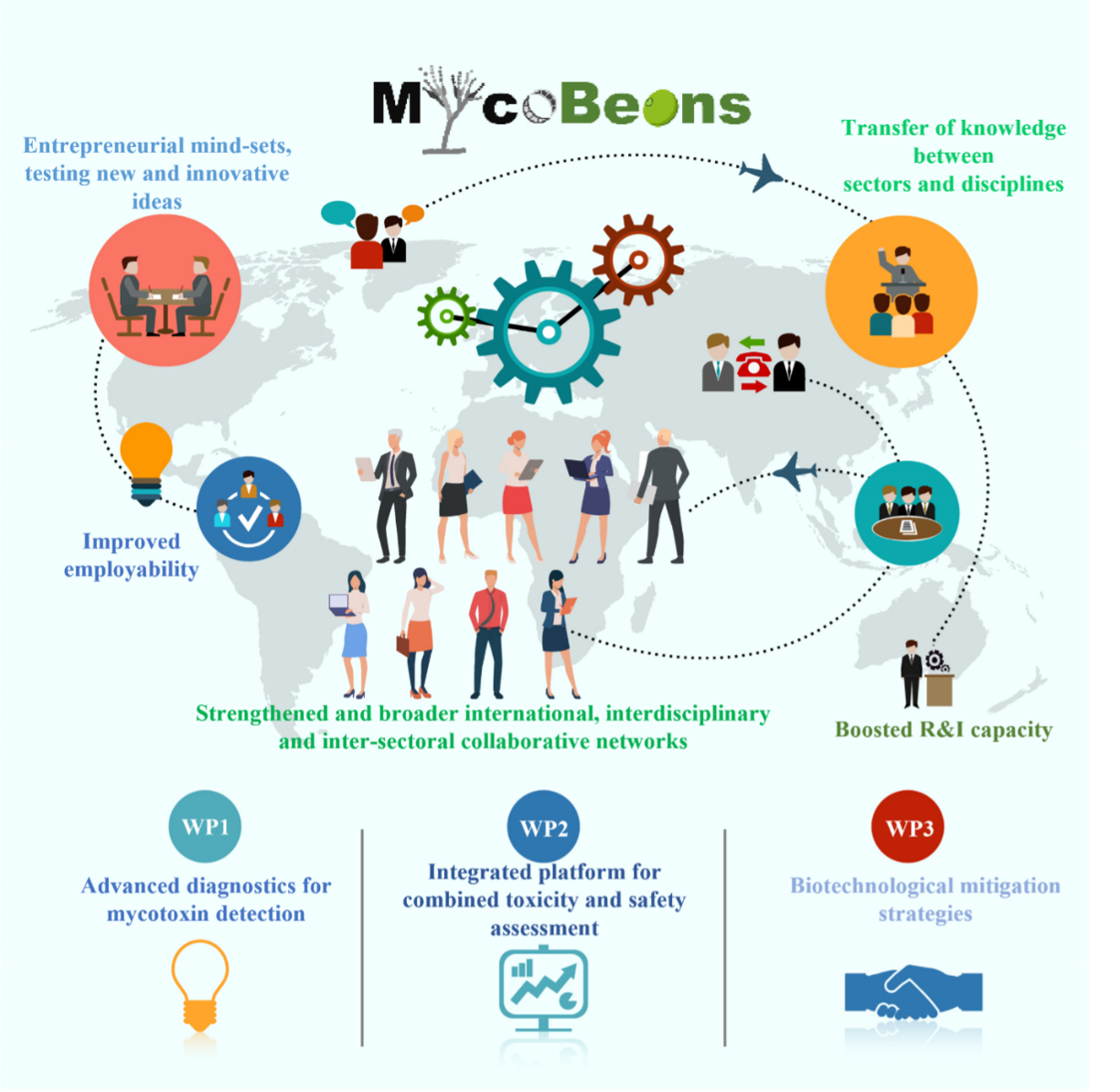
MYCOBEANS is built around five closely connected Work Packages (WPs) that work together to turn scientific knowledge into real-world impact. Each WP plays a distinct role, guiding the project from understanding food safety challenges to developing practical solutions and ensuring that results reach the people who need them.
WP1 — Advanced diagnostics for mycotoxin detection (Lead: TU; M1-M42)
Why: The first step to solving a problem is to see it clearly. In WP1, MYCOBEANS focuses on understanding where, when, and how mycotoxins appear along the food chain, with a special attention to plant-based ingredients and products that are increasingly important in our diets. Our goal is to build a realistic picture of mycotoxin contamination in raw materials and processed foods, capturing the complexity of real-life situations rather than isolated cases. By bringing together expertise from academia, industry, and international partners, WP1 connects food production, global trade, and consumer exposure into a single, coherent vision. This work package lays the foundation for the entire project: without reliable knowledge of the problem’s scale and context, no meaningful safety strategy can exist. WP1 is about turning uncertainty into knowledge and creating a shared reference point for smarter decisions in food safety.
WP2 — Integrated platform for combined toxicity and safety assessment (Lead: UNIVIE; M6-M42)
Why: Detecting mycotoxins is not enough. To protect consumers, we must understand their real biological impact. WP2 addresses this challenge by exploring how mycotoxins — alone or in combination — interact with the human body. Rather than focusing on extreme scenarios, WP2 looks at realistic exposure conditions, reflecting how people actually encounter these contaminants through everyday foods. The aim is to clarify potential health effects, identify sensitive biological targets, and understand why certain combinations may pose higher risks than expected. By linking food contamination to biological response, WP2 transforms chemical presence into meaningful health information. This knowledge is essential for evidence-based risk assessment and for designing food systems that are not only compliant, but genuinely safer
WP3 — Biotechnological mitigation (Lead: NSTDA; M6-M48)
Why: WP3 is where knowledge becomes action. Building on what we learn in WP1 and WP2, this work package focuses on practical strategies to reduce mycotoxins in foods and ingredients, without compromising quality, sustainability, or consumer trust. The objective is to explore and validate nature-inspired and industry-relevant solutions that can be applied along the food chain — from raw materials to processing. WP3 bridges science and real-world application, working closely with food producers to ensure that proposed solutions are realistic, scalable, and compatible with modern food systems. Ultimately, WP3 is about moving beyond risk management toward risk prevention, contributing to safer foods and more resilient production chains.
WP4 — Knowledge transfer and public engagement (Lead: QUB; M1-M48)
Why: Science creates value only when it moves beyond the lab. WP4 is dedicated to making the knowledge generated by MYCOBEANS accessible, usable, and impactful for people who can turn it into real change. This work package focuses on training researchers and professionals, strengthening international collaboration, and fostering a shared culture of food safety across academia, industry, and policy-related environments. WP4 promotes the exchange of expertise, perspectives, and best practices, ensuring that skills developed within the project continue to circulate long after its end. By connecting people as much as data, WP4 amplifies the project’s impact and helps translate scientific advances into informed decisions, improved practices, and long-term capacity building in food safety.
WP5 — Project management, dissemination and exploitation (Lead: UNIPR; M1-M48)
Why: WP5 ensures that MYCOBEANS runs smoothly, stays aligned with its goals, and delivers high-quality results through effective coordination, communication, and strategic oversight.